A wall-mounted squat rack can turn unused wall space into a capable strength-training station without taking over your entire home gym. The best options combine secure installation, useful attachments, and a folding or compact design that fits your training space.
These 10 wall-mounted squat racks cover a range of priorities, from straightforward squat and pull-up training to more versatile setups with pulley systems, cable crossovers, and multiple attachments. Before choosing, confirm the wall structure, available clearance, and equipment dimensions.
Best 10 Wall Mounted Squat Racks Picks for 2026
Best Folding Value
Mikolo Folding Wall Mounted Squat Rack

- Folds for compact storage
- 1,000-pound stated capacity
- Includes pull-up bar, J-hooks, and row attachment
Best For: Space-conscious lifters focused on barbell training
Best Cable Versatility
Mdeam Folding Squat Rack With Pulley System

- Dual 1:1 cable pulley system
- Seven adjustable rack angles
- Includes landmine and pull-up bar
Best For: Households wanting varied cable and strength workouts
Best Simple Setup
SPORTSOUL Wall Mounted Squat Rack
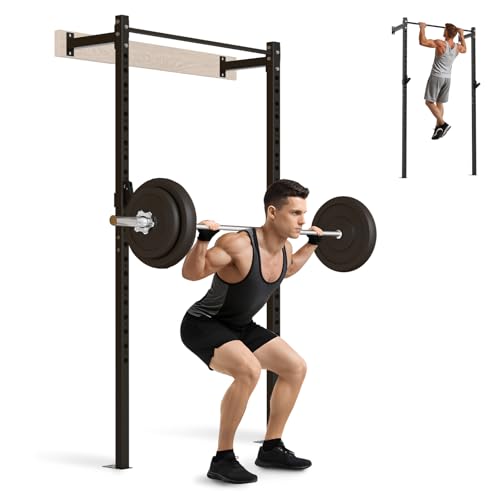
- 900-pound stated rack capacity
- 22 numbered J-hook positions
- Universal holes for compatible accessories
Best For: Lifters wanting a basic, expandable rack
Best All-in-One Trainer

- Five configurable training modes
- Dual independent 1:1 pulleys
- Folds to a stated 4.3 square feet
Best For: Users replacing several gym stations with one unit
Best Space-Saving Pick
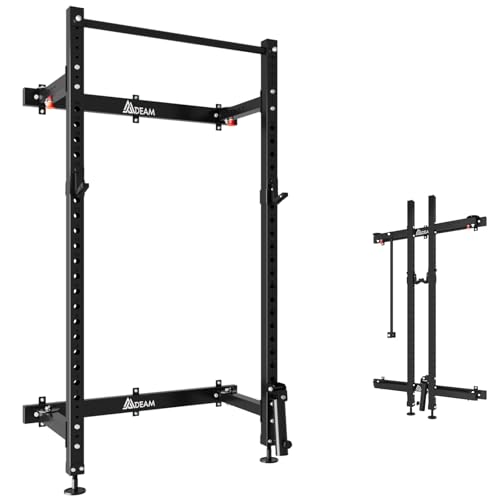
- Folds for compact storage
- 1,000-pound listed capacity
- Includes pull-up bar and landmine
Best For: Home gyms prioritizing storage space and exercise variety
Best Full-Featured Station
Megastar Dual-Crossover Power Cage

- 2,000-pound listed capacity
- Integrated dual cable crossover
- Supports over 80 listed exercises
Best For: Advanced home gyms wanting cable and barbell training
Best Adjustable Folding Option

- Folds to a 2-inch depth
- 1,100-pound listed capacity
- Adjustable pull-up bar and landmine
Best For: Compact gyms needing flexible barbell and pull-up training
Best with Extra Features
JELENS FS01 Folding Squat Rack

- Folds to 2.08 square feet
- Stated 1,100-pound safe capacity
- Includes J-hooks, safety bars, and landmine
Best For: Compact home gyms needing a fold-away rack
Best Heavy-Duty Pick
Mikolo Folding Cable Squat Rack

- Five adjustable training configurations
- Integrated cable crossover and lat pulldown
- Stated 1,000-pound capacity
Best For: Full-body home gyms wanting integrated cable training
Best Pulley Adjustability
Mikolo Cheetah 2.0 Folding Rack

- 28 pulley height options
- Dual cable crossover with 2:1 ratio
- Folds to about 3 square feet
Best For: Compact gyms prioritizing adjustable cable exercises
Best Folding Value – Mikolo Folding Wall Mounted Squat Rack
The Mikolo is a practical choice for shoppers comparing wall mounted squat racks for a space-conscious home gym. Its folding frame stores in about 15 seconds, while 2-inch-by-2-inch, 13-gauge steel uprights support up to 1,000 pounds for squats, deadlifts, and bench presses.
Best For: Lifters who want a fold-away rack with a pull-up bar, J-hooks, safety catches, and a landmine-style row attachment.
Pros:
- Folds from its open configuration for easier storage in compact spaces.
- 1,000-pound stated capacity with 13-gauge steel uprights.
- Includes a quick-attach pull-up bar, J-cups with protective inserts, and a 360-degree dual-size T-bar row attachment.
- Stringer and metal studs are included, with an estimated 15- to 30-minute installation.
Cons:
- The 47-inch-wide frame still requires suitable wall space and secure installation.
- The listed warranty information is inconsistent, with the notes mentioning both one-year parts replacement and a two-year warranty.
Choose this Mikolo model if basic barbell training and quick storage matter more than an integrated cable system. Verify the wall structure and mounting requirements before installation.
Best Cable Versatility – Mdeam Folding Squat Rack With Pulley System
The Mdeam stands out among wall mounted squat racks by combining a folding power rack with a dual cable pulley system. Its 1:1 pulley ratio, seven adjustable angles, and included landmine expand the range of movements available in a compact home gym.
Best For: Families or home-gym users who want independent cable training, pull-ups, landmine work, and rack exercises in one setup.
Pros:
- Dual independent pulleys use a 1:1 ratio for crossover-style movements.
- Folding design and seven adjustable angles help accommodate smaller spaces.
- Integrates a power cage, cable crossover, lat-pulldown functions, pull-up bar, and 360-degree landmine.
- The product notes state support for up to 1,000 pounds and simultaneous use by up to three people.
Cons:
- At 151 pounds packaged, it may require more effort to move and install than a basic rack.
- The listed warranty is one year.
This is a strong fit when exercise variety is a priority. Its broader functionality also means buyers should plan carefully for wall mounting, floor space, and the included cable components.
Best Simple Setup – SPORTSOUL Wall Mounted Squat Rack
The SPORTSOUL is a straightforward option for shoppers seeking wall mounted squat racks without an integrated pulley system. It uses 2-inch-by-2-inch steel uprights, 22 numbered J-hook positions, and a universal-hole design for adding compatible accessories.
Best For: Home lifters who want a compact rack for squats, presses, pull-ups, and future accessory upgrades.
Pros:
- 900-pound stated capacity with a powder-coated 2-inch-by-2-inch steel frame.
- Twenty-two numbered J-hook positions make height adjustments easier.
- Knurled 86.3-inch pull-up bar provides a secure grip.
- Universal 1-inch holes are designed to fit accessories such as dip bars, safety arms, and a landmine.
Cons:
- Accessory equipment beyond the included power rack is not listed as included.
- The product has a 300-pound maximum user-weight specification in addition to its rack capacity.
- Its fixed wall-floor setup may be less convenient to store than a folding design.
Consider the SPORTSOUL when you want a relatively simple, adjustable rack and prefer to build out accessories over time. The included assembly hardware and video guide may also appeal to first-time rack buyers.
Best All-in-One Trainer – WM3-V4 Folding Squat Rack
The WM3-V4 is aimed at buyers who want more than a basic rack from their wall mounted squat racks. It folds to a stated 4.3 square feet, expands to 12.3 square feet, and combines a power rack, dual cable crossover, lat-pulldown station, pull-up bar, and adjustable pulley system.
Best For: Users seeking a highly versatile folding station for barbell lifts, cable work, pull-ups, and partner training.
Pros:
- Five configurable modes include folded, semi-open, half-rack, functional-trainer, and cable-crossover positions.
- Dual independent 1:1 pulleys support simultaneous workouts and supersets.
- Fifteen adjustable pulley heights and quick-swap accessories support more than 80 stated exercises.
- The product lists a 2,000-pound maximum weight recommendation and alloy-steel construction.
Cons:
- The extensive functionality may make setup and space planning more involved than with a basic rack.
- The listed warranty is one year.
- Installation materials are described as a manual and two-box shipment, so buyers should plan for assembly.
The WM3-V4 makes the most sense when one compact station needs to cover several training styles. Its multiple modes and cable adjustments offer flexibility, but careful installation and adequate clearance are especially important.
Best Space-Saving Pick – Mdeam Folding Squat Rack
If you need wall mounted squat racks for a home, garage, or basement gym, the Mdeam Folding Squat Rack emphasizes quick storage and a broad exercise setup. It folds in about 15 seconds and includes a pull-up bar, J-hooks, and 360° landmine attachment.
Best For: Home gym users who want a foldable rack with multiple built-in training options.
Pros:
- Folds from a 25-inch-deep setup to a compact wall-mounted storage position.
- 60x60mm steel uprights and a listed 1,000-pound capacity support demanding workouts.
- Includes stabilizer leveling feet, J-hooks, pull-up bar, and landmine attachment.
- Manufacturer states installation can take approximately 15–30 minutes.
Cons:
- The listed 87-inch height may be limiting in rooms with low ceilings.
- Wall mounting is required, so installation depends on a suitable wall and secure attachment.
Overall, this is a practical choice when floor space is limited and you want a relatively straightforward folding rack for squats, presses, pull-ups, and landmine movements.
Best Full-Featured Station – Megastar Dual-Crossover Power Cage
Among wall mounted squat racks, this Megastar power cage stands out for combining a wall-mounted frame with a dual cable crossover system. Its 50x70mm commercial steel tubing, pull-up bar, landmine, and broad attachment package are designed for extensive strength training in compact spaces.
Best For: Lifters seeking a highly versatile, commercial-style home gym station with integrated cable training.
Pros:
- Listed 2,000-pound overall capacity with sandwich J-cups rated for 1,000 pounds and safety arms for 800 pounds.
- Projects only 21.5 inches from the wall and stands 83.5 inches high.
- Dual cable crossover, multi-grip pull-up bar, and landmine support more than 80 listed exercises.
- Includes two-year support and lifetime part replacement support according to the supplied notes.
Cons:
- The feature-rich design may require more assembly time; the stated estimate is about 90 minutes.
- Its extensive cable and attachment system may be more equipment than needed for basic barbell training.
This rack is the strongest fit for buyers who want a compact but comprehensive training station rather than a basic folding squat setup.
Best Adjustable Folding Option – MU 2×2 Folding Squat Rack
This MU folding rack is one of the more adaptable wall mounted squat racks for a home gym, garage, or training studio. Its slim folded profile, adjustable pull-up bar, landmine, and accessory-ready 1-inch holes provide flexibility without occupying much floor space.
Best For: Users who want a foldable rack with adjustable pull-up training and room to add compatible accessories.
Pros:
- Folds to a listed 2-inch depth while using the wall to preserve floor space.
- Supports up to 1,100 pounds according to the supplied specifications.
- Includes two J-hooks, a LAT pull-up bar, and a detachable 360° landmine.
- Adjustable 80-inch pull-up bar and universal 1-inch holes support varied setups.
Cons:
- The rack is 85.8 inches tall, which may not suit every ceiling height.
- Additional accessories such as spotter arms or cable systems are not listed as included.
With its especially narrow folded profile and adjustable pull-up bar, the MU is a sensible middle ground for buyers who want a compact rack that can expand with their training needs.
Best with Extra Features – JELENS FS01 Folding Squat Rack
If you need wall mounted squat racks for a home gym where floor space matters, the JELENS FS01 offers a sturdy folding design with useful rack attachments. It folds flat to just 2.08 square feet and opens in about 15 seconds.
Best For: Home gym users who want a fold-away power rack for squats, bench presses, pull-ups, and barbell training.
Pros:
- Heavy-duty 2-by-2-inch steel construction with a stated 1,100-pound safe weight capacity.
- Folds flat when not in use and opens to a full power-cage configuration.
- Includes J-hooks, safety bars, a pull-up bar, and a 360-degree landmine attachment.
- Pre-drilled stringers and multiple mounting holes support a customizable installation.
Cons:
- Installation requires wall mounting and is recommended for two people.
- Its 76.8-pound weight and fixed wall installation may require careful planning before assembly.
The JELENS FS01 is a practical choice when compact storage and basic power-rack versatility are more important than an integrated cable system. Its safety bars and broad attachment compatibility add useful flexibility for home workouts.
Best Heavy-Duty Pick – Mikolo Folding Cable Squat Rack
Among wall mounted squat racks, this Mikolo model stands out for combining a folding power rack with cable crossover and lat pulldown functions. It folds to about 3 square feet and expands to approximately 9.5 square feet for training.
Best For: Users who want one wall-mounted station for barbell work, pull-ups, cable exercises, and partner-friendly training.
Pros:
- Combines a power rack, cable crossover, lat pulldown, and pull-up bar.
- Offers five configurations, including folded, power rack, functional trainer, and cable crossover modes.
- Uses 2-by-2-inch 14-gauge steel, reinforced wall mounts, and four adjustable ground supports.
- Provides 15 pulley height positions and a stated 1,000-pound capacity.
Cons:
- At 150 pounds, it is substantially heavier than a basic folding rack.
- The supplied dimensions are listed as 2 by 14 by 2 inches, so buyers should confirm assembled dimensions before purchase.
This Mikolo is a strong fit for lifters seeking broad exercise variety without buying separate cable equipment. Its folding footprint is useful, although the heavier all-in-one design demands careful wall installation and available training clearance.
Best Pulley Adjustability – Mikolo Cheetah 2.0 Folding Rack
This Mikolo Cheetah 2.0 is one of the more versatile wall mounted squat racks for compact gyms, pairing a folding rack with dual cable crossover and lat pulldown functions. It folds to about 3 square feet and opens to roughly 9.5 square feet.
Best For: Lifters who want extensive pulley-position adjustment for strength training, cable work, and shared workouts.
Pros:
- Includes power-rack, functional-trainer, cable-crossover, and lat-pulldown capabilities.
- Features a dual cable crossover with a 2:1 pulley ratio.
- Offers 28 pulley height options, plus a detachable pull-up bar and J-hooks.
- Uses 2-by-2-inch 14-gauge steel with reinforced wall mounts and adjustable ground supports.
Cons:
- The 2:1 pulley ratio provides less resistance at the handle than a 1:1 system.
- Wall mounting and ground-support adjustment add installation considerations.
- The supplied package information lists a 44.3-pound weight, so buyers should verify the complete assembled configuration.
The Cheetah 2.0 is appealing when cable versatility and fine adjustment matter most. Its 28 pulley positions expand exercise options, while the folding layout helps preserve space in a basement, garage, or home gym.
How We Picked the Best Wall Mounted Squat Racks
We compared these wall-mounted squat racks by looking at the features that matter most in a home strength setup: frame construction, stated weight capacity, mounting design, folding convenience, pull-up functionality, attachment compatibility, and cable-system versatility. We also considered whether each rack suits a compact training area or requires more room for plate loading, pulley movement, and walkout clearance.
Capacity claims are useful for comparison, but they should not be treated as a substitute for correct installation. The wall, fasteners, floor, and assembly all affect real-world stability and safe performance.
Quick Comparison
| Rack type | Best for | Features to prioritize |
|---|---|---|
| Basic folding rack | Squats, presses, and pull-ups | Rigid frame, reliable J-hooks, secure hinges |
| Rack with attachments | Exercise variety | Compatible accessories, storage, adjustable pull-up bar |
| Cable-equipped rack | Full-body training | Adjustable pulley positions, smooth cable travel, included handles |
| High-capacity power rack | Heavier barbell training | Strong mounting points, substantial uprights, appropriate hardware |
Key Buying Factors for Wall-Mounted Squat Racks
Wall and Mounting Requirements
Check whether the rack is designed for studs, masonry, or another structural surface. Measure stud spacing, ceiling height, and the available wall width before ordering. A rack mounted to unsuitable material may be unsafe regardless of its advertised capacity.
Folded and Open Dimensions
Folding models save space only when they can open and close comfortably. Account for barbell length, plate loading, bench placement, and clearance behind the uprights. Verify hinge or locking mechanisms are substantial and easy to operate.
Capacity and Frame Specifications
Compare the stated load rating with your current lifts and likely progression. Look for clearly listed steel dimensions, hardware details, hole spacing, and safety features. J-hooks and safety arms should support the bar securely at the positions you use most.
Attachments and Cable Systems
Pull-up bars, landmines, dip handles, pulley systems, and lat-pulldown accessories can expand training options, but they also add setup complexity. For cable work, consider adjustment range, pulley travel, resistance ratio, included attachments, and whether plates or a weight stack are required.
Who Should Buy Which Wall Mounted Squat Racks?
Choose a simple folding rack if your priority is barbell squats, bench presses, overhead presses, and pull-ups in a compact room. Choose a rack with more attachments if you want one station for varied accessory work and have adequate storage space. A cable-equipped model is the better fit for users who want functional training, rows, pulldowns, and isolation exercises alongside barbell lifts.
Heavier lifters and serious strength trainees should focus first on structural compatibility, mounting quality, safety hardware, and frame rigidity rather than the largest advertised capacity. If you rent, cannot verify a structural mounting surface, or need a freestanding setup, a wall-mounted rack may not be the right choice.