The best handheld GPS devices with long battery life help hikers, hunters, boaters, and backcountry travelers stay oriented without relying on a phone signal.
We compare 10 rugged options based on battery endurance, satellite accuracy, mapping features, durability, and ease of use so you can choose the right navigator for your trips.
Best 10 Handheld Gps Devices with Long Battery Life Picks for 2026
Best Solar Pick

- Up to 200 hours without solar charging
- Unlimited battery life in suitable sunny conditions
- Multi-band GPS and IPX7 water resistance
Best For: Long trips in sunny outdoor conditions
Best Accuracy-Focused Option

- Multi-band and expanded GNSS support
- 2.6-inch sunlight-readable color display
- Preloaded TopoActive and public land maps
Best For: Accurate navigation in challenging terrain
Best Replaceable-Battery Value

- Up to 168 hours standard or 1,800 hours expedition
- Uses two replaceable AA batteries
- Multi-GNSS support with IPX7 water resistance
Best For: Extended trips where field-swappable batteries matter
Best Feature-Rich Navigator

- Up to 36 hours standard or 450 hours expedition
- 3-inch display with multi-band GNSS
- Compass, altimeter, maps, and BirdsEye imagery
Best For: Serious outdoor navigation with advanced features
Best All-Around Navigator

- Up to 25 hours on two AA batteries
- TopoActive maps with routable trails
- 3-axis compass and barometric altimeter
Best For: Hikers and cyclists wanting replaceable batteries and versatile navigation
Longest Battery Life

- Up to 425 hours in expedition mode
- inReach messaging and interactive SOS
- 3-inch display with multi-band GNSS
Best For: Remote travelers needing extended tracking and satellite communication
Best Simple GPS Value

- Up to 25 hours on two AA batteries
- Preloaded TopoActive maps
- Button controls and microSD expansion
Best For: Campers and hikers wanting simple, durable basic navigation
Best Marine Pick
- Floats and has IPX6 water resistance
- Up to 20 hours in GPS mode
- Supports multiple satellite constellations
Best For: Boating, fishing, and wet outdoor conditions
Best Battery Life
- Up to 168 hours standard or 1,800 hours expedition
- Uses two replaceable AA batteries
- Sunlight-readable 2.2-inch display
Best For: Extended trips where recharging is difficult
Best Rechargeable Option

- Up to 36 hours per charge
- USB-C rechargeable battery
- USA Topo maps with 32 GB storage
Best For: Hiking and camping in the United States
Best Solar Pick – Garmin eTrex Solar
For hikers seeking handheld GPS devices with long battery life, the Garmin eTrex Solar stands out with solar charging and a compact, sunlight-readable display. It can provide unlimited battery life in sunny conditions rated at 75,000 lux, or up to 200 hours without solar charging.
Best For: Hikers and campers who prioritize maximum runtime and straightforward navigation.
Pros:
- Solar charging can deliver unlimited battery life in suitable sunny conditions.
- Multi-band GPS is designed to improve positional accuracy.
- IPX7 water resistance and a digital compass support use in variable outdoor conditions.
Cons:
- The 2.2-inch screen is smaller than the displays on the GPSMAP models.
- Solar performance depends on receiving sufficient sunlight.
- Mapping and connected features require pairing with a compatible smartphone for some functions.
The eTrex Solar is a strong choice when battery endurance matters most, especially for sunny trips where solar charging can reduce reliance on conventional recharging.
Best Accuracy-Focused Option – Garmin GPSMAP 65
The Garmin GPSMAP 65 is a practical choice among handheld GPS devices with long battery life for users who need expanded satellite support in difficult surroundings. Its multi-band technology and expanded GNSS support are intended to improve accuracy in forests, steep terrain, and urban canyons.
Best For: Hikers, hunters, and outdoor users who value positioning accuracy and preloaded mapping.
Pros:
- Multi-band technology and expanded GNSS support help in challenging locations.
- Sunlight-readable 2.6-inch color display is easy to view outdoors.
- Includes routable TopoActive mapping and U.S. federal public land mapping.
Cons:
- Battery life is rated at up to 16 hours, shorter than the other listed options.
- Some app and website features require a compatible smartphone.
- Its button-operated interface may feel less convenient than a touchscreen.
The GPSMAP 65 favors dependable satellite performance and useful built-in maps over extreme battery endurance, making it better suited to shorter outings or trips with access to spare power.
Best Replaceable-Battery Value – Garmin eTrex SE
The Garmin eTrex SE combines a compact design with unusually flexible battery performance, making it a compelling option among handheld GPS devices with long battery life. Its two field-replaceable AA batteries provide up to 168 hours in standard mode or up to 1,800 hours in expedition mode.
Best For: Backpackers and campers who want long runtime with easy-to-replace AA batteries.
Pros:
- Offers up to 1,800 hours in expedition mode.
- Uses two field-replaceable AA batteries, which are not included.
- Multi-GNSS support and a digital compass support navigation in more challenging environments.
- IPX7 water resistance and a sunlight-readable display suit outdoor use.
Cons:
- AA batteries must be purchased separately.
- The 2.2-inch display is relatively compact.
- Some mapping, weather, update, and geocaching features require a compatible smartphone and Garmin Explore.
The eTrex SE is especially appealing for extended trips because its replaceable batteries can be swapped in the field, while expedition mode stretches runtime dramatically when fewer active features are needed.
Best Feature-Rich Navigator – Garmin GPSMAP 66sr
The Garmin GPSMAP 66sr is built for outdoor users who want advanced navigation features alongside extended battery options. It provides up to 36 hours in standard mode or up to 450 hours in expedition mode, with a larger 3-inch display, multi-band GNSS, and built-in outdoor sensors.
Best For: Serious hikers and hunters who want detailed navigation tools and long expedition-mode runtime.
Pros:
- Expedition mode extends battery life to up to 450 hours.
- Multi-band technology and expanded GNSS support improve positioning in challenging environments.
- Includes a 3-axis compass, barometric altimeter, TopoActive mapping, and BirdsEye satellite imagery access.
- The 3-inch sunlight-readable color display is the largest among these models.
Cons:
- Standard-mode battery life is up to 36 hours, below the eTrex models.
- It uses an internal rechargeable Li-ion battery rather than field-replaceable batteries.
- Its larger feature set may be more than casual navigators need.
The GPSMAP 66sr is the most capable all-around option here for users who need sensors, mapping, and satellite imagery, while expedition mode provides substantial endurance for longer adventures.
Best All-Around Navigator – Garmin eTrex 32x
For hikers and cyclists seeking handheld GPS devices with long battery life, the Garmin eTrex 32x combines a compact, sunlight-readable display with up to 25 hours of GPS use from two AA batteries. Its preloaded maps, GPS and GLONASS support, and rugged handheld design make it practical for everyday outdoor navigation.
Best For: Hikers and cyclists who want dependable mapping, replaceable batteries, and added elevation and direction data.
Pros:
- Up to 25 hours of battery life with two AA batteries
- Preloaded TopoActive maps include routable roads and trails
- 3-axis compass and barometric altimeter add useful navigation data
- 8 GB of internal storage plus a microSD card slot
Cons:
- Its 2.2-inch display is smaller than the screen on the GPSMAP 67i
- Uses AA batteries rather than an internal rechargeable battery
The eTrex 32x is a balanced choice for users who value simplicity, expandable mapping, and the convenience of swapping in fresh AA batteries on longer outings.
Longest Battery Life – Garmin GPSMAP 67i Renewed
The renewed Garmin GPSMAP 67i stands out among handheld GPS devices with long battery life, offering up to 165 hours in 10-minute tracking mode or 425 hours in expedition mode. It also adds inReach satellite messaging, interactive SOS, multi-band GNSS, and a larger 3-inch display for demanding trips.
Best For: Backcountry travelers who need extended tracking, satellite communication, and emergency-response capabilities.
Pros:
- Up to 425 hours in expedition mode or 165 hours in 10-minute tracking mode
- Two-way messaging and interactive SOS use the global Iridium satellite network
- Large 3-inch sunlight-readable display with preloaded TopoActive maps
- Multi-band GNSS, satellite imagery access, and weather features support trip planning
Cons:
- Satellite messaging and SOS require an active subscription
- Renewed unit includes a 90-day limited warranty
- Satellite communications may be regulated or prohibited in some jurisdictions
With exceptional endurance and communication features, the GPSMAP 67i is the strongest option here for remote travel, provided you account for the subscription requirement and renewed-product warranty.
Best Simple GPS Value – Garmin eTrex 22x
The Garmin eTrex 22x is a straightforward choice for shoppers comparing handheld GPS devices with long battery life. It runs for up to 25 hours on two AA batteries and includes a 2.2-inch sunlight-readable display, preloaded TopoActive maps, and GPS/GLONASS support for hiking, camping, and vehicle use.
Best For: Campers, hikers, and vehicle users who prefer button controls and dependable basic mapping.
Pros:
- Up to 25 hours of GPS operation with two AA batteries
- Preloaded TopoActive maps show routable roads and trails
- 8 GB of internal memory supports map downloads, with microSD expansion
- Compact, lightweight handheld design with button controls
Cons:
- No 3-axis compass or barometric altimeter listed
- Smaller 2.2-inch display provides less viewing area than the GPSMAP 67i
- Does not include the GPSMAP 67i’s satellite messaging and SOS functions
The eTrex 22x keeps navigation focused on the essentials, making it a sensible fit when long AA-battery runtime and simple controls matter more than advanced sensors or satellite communication.
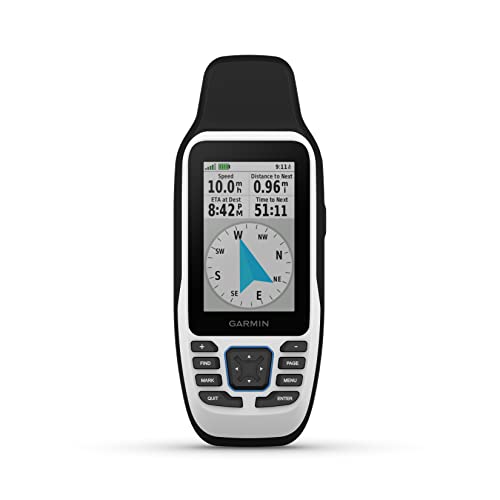
Best Marine Pick – Garmin GPSMAP 79s
Garmin GPSMAP 79s, Marine GPS Handheld with Worldwide Basemap, Rugged Design and Floats in Water
Check Price On AmazonFor shoppers comparing handheld GPS devices with long battery life, the Garmin GPSMAP 79s is a rugged marine-oriented option with up to 20 hours of GPS use. Its floating, water-resistant design, worldwide basemap, and navigation sensors make it especially practical for boating and fishing trips.
Best For: Boating, fishing, and outdoor navigation where a floating, durable device is valuable.
Pros:
- Floats in water and has an IPX6 water-resistant design.
- Supports GPS, GLONASS, BeiDou, Galileo, QZSS, and SBAS satellite systems.
- Stores up to 10,000 waypoints, 250 routes, and 300 fit activities.
- Includes a 3-axis electronic compass and barometric altimeter.
Cons:
- Battery life is up to 20 hours, shorter than some expedition-focused handhelds.
- Uses physical buttons rather than a touchscreen.
- The IPX6 rating is specified at the unit level only.
The GPSMAP 79s is a strong choice when rugged marine use and floating protection matter more than maximum runtime. Its 20-hour battery rating should cover many day trips, while its expanded storage supports detailed trip planning.
Best Battery Life – Garmin eTrex SE
The renewed Garmin eTrex SE stands out among handheld GPS devices with long battery life, offering up to 168 hours in standard mode and up to 1,800 hours in expedition mode. Its replaceable AA batteries, sunlight-readable display, and multi-GNSS support suit extended trips away from power outlets.
Best For: Backpackers, hikers, and travelers who prioritize exceptional runtime and replaceable batteries.
Pros:
- Provides up to 168 hours in standard mode and 1,800 hours in expedition mode.
- Uses two field-replaceable AA batteries.
- Supports GPS, GLONASS, Galileo, BeiDou, and QZSS.
- Pairs with the Garmin Explore app for updates, trip planning, and additional features.
Cons:
- AA batteries are not included.
- This is a renewed product with a 90-day limited warranty.
- The monochrome display is smaller at 2.2 inches.
With an unusually long expedition-mode rating and field-replaceable batteries, the eTrex SE is the clearest fit for multi-day or extended outings. Its renewed status and shorter warranty are worth weighing against the impressive runtime.
Best Rechargeable Option – NiesahYan Handheld GPS
This compact NiesahYan navigator is a practical entry in handheld GPS devices with long battery life, delivering up to 36 hours on a full charge. It combines a sunlight-readable 3.2-inch screen, USB-C recharging, USA Topo maps, and multi-GNSS support for hiking and camping.
Best For: Hikers and campers seeking a rechargeable GPS with preloaded USA topographic maps.
Pros:
- Offers up to 36 hours of battery life and recharges via USB-C.
- Includes preloaded USA Topo maps and 32 GB of internal memory.
- Supports GPS, Galileo, BeiDou, and QZSS.
- Features a 3-axis compass, barometric altimeter, and sunlight-readable 3.2-inch screen.
Cons:
- Its IP66 water-resistance rating is lower than full waterproofing.
- Mapping is specified as USA Topo rather than worldwide coverage.
- The product has less established brand information than the Garmin alternatives.
The NiesahYan offers a useful middle ground between screen size, storage, and runtime. It is particularly appealing if you want rechargeable convenience and USA trail maps, though buyers should match its regional mapping and IP66 protection to their intended routes.
How We Picked the Best Handheld Gps Devices with Long Battery Life
We focused on devices designed for extended outdoor use, prioritizing published battery performance, satellite-system support, screen readability, weather resistance, and practical navigation features. Models with multi-GNSS or multi-band technology can improve positioning in challenging terrain, while wireless connectivity and downloadable maps add convenience for trip planning.
We also considered the type of user each device serves. A simple button-operated navigator may be preferable in rain or cold, while a model with a larger color display, advanced mapping, or satellite messaging may justify its higher price for more demanding adventures.
Quick Comparison
- Best for solar-assisted use: Garmin eTrex Solar.
- Best for accurate positioning: Garmin GPSMAP 65 or GPSMAP 66sr.
- Best for satellite communication: Garmin GPSMAP 67i.
- Best for simple navigation: Garmin eTrex 22x or eTrex 32x.
- Best for marine use: Garmin GPSMAP 79s.
- Best budget-style alternative: The rugged 3.2-inch handheld GPS navigator listed in this roundup.
Key Buying Factors for Handheld Gps Devices with Long Battery Life
Battery Type and Runtime
Check whether the device uses replaceable AA batteries, a rechargeable pack, solar assistance, or a combination. Replaceable batteries are useful on multiday trips because you can carry spares, while rechargeable models are convenient for regular use. Compare runtime across the same tracking and display settings; frequent navigation, wireless syncing, and bright backlighting can reduce endurance.
Satellite Accuracy and Coverage
Multi-GNSS support uses more satellite networks, and multi-band reception can improve accuracy near cliffs, dense forests, and urban structures. These features are valuable for precise tracks but may not be necessary for casual trail navigation.
Maps, Screen, and Controls
Look for preloaded maps, compatibility with downloadable cartography, a sunlight-readable display, and controls you can operate with gloves. Buttons tend to work reliably in wet conditions, while touchscreens can make map browsing faster in favorable weather.
Ruggedness and Emergency Features
Water resistance, shock protection, and a durable case matter when equipment faces rain, drops, dust, or cold. Satellite messaging and SOS capabilities can add an important safety layer, but they typically require a subscription and a clear view of the sky.
Who Should Buy Which Handheld Gps Devices with Long Battery Life?
Choose an eTrex model if you want compact, straightforward navigation and strong battery efficiency. Pick a GPSMAP 65 or 66sr when positioning accuracy and expanded satellite support are priorities. The GPSMAP 67i is better suited to remote travelers who need two-way messaging and emergency communication. Boaters should consider the floating GPSMAP 79s, while occasional hikers may prefer a simpler rugged navigator with a readable screen and familiar controls.