Inflating a stand-up paddleboard by hand can take time and energy before you even reach the water. The best paddleboard pumps make setup simpler by combining automatic shutoff, high-pressure performance, and useful inflation and deflation modes.
This roundup compares 10 electric SUP pumps, including rechargeable models and 12V car-powered options, so you can choose the right balance of speed, portability, battery capacity, and convenience.
Best 10 Paddleboard Pumps Picks for 2026
Best High-Capacity Pick
Portable 50 PSI Rechargeable SUP Pump

- 12,000mAh battery handles up to four boards at 12 PSI
- Three-stage inflation with automatic shutoff and deflation
- 2.9-pound body includes a bag, display, and built-in light
Best For: Group outings and extended battery-powered use
Best Fast-Charging Option
OutdoorMaster Shark 3 SUP Pump

- Inflates a 15 PSI board in 3 minutes 50 seconds
- 74Wh battery supports up to four SUPs
- Type-C, vehicle input, auto-off, and eight nozzles
Best For: Fast inflation and flexible charging on travel days
Best Budget Car-Powered Pick
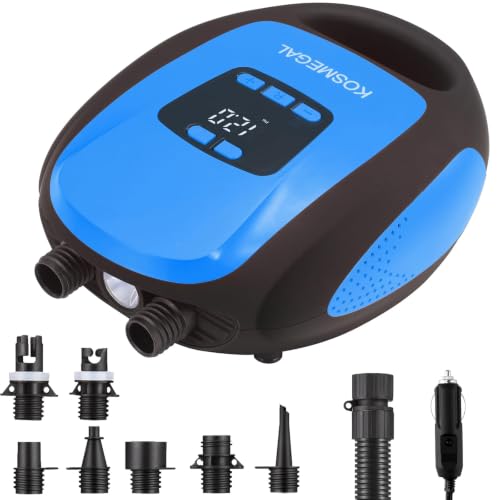
- 12V car-powered design needs no rechargeable battery
- Auto-off, backlit display, and flashlight simplify setup
- Six nozzles and a carry bag support varied inflatables
Best For: Car-accessible launches and simple SUP inflation
Best Lightweight Rechargeable Pick

- 2.5-pound rechargeable pump inflates to 12 PSI in about five minutes
- Battery handles three boards at 12 PSI
- Seven nozzles, auto-off, deflation, and waterproof bag included
Best For: Solo paddlers who value portability and cordless setup
Best Car-Powered Value

- 12V vehicle-powered operation
- LCD pressure display and auto operation
- Inflation and deflation with six adapters
Best For: Car-based SUP outings and everyday inflatable setup
Best Rechargeable Option

- 15,600mAh rechargeable battery
- Inflates a SUP to 12 PSI in under seven minutes
- Auto-off, cooling system, and LED display
Best For: Group outings and repeated cordless inflation
Best Multipurpose Car Pump

- SUP, tire, and deflation modes
- 12 PSI SUP inflation in about six minutes
- 10-foot cable and eight universal adapters
Best For: Road trips requiring one pump for gear and tires
Best Cordless Pick

- Inflates about 3–4 boards per charge
- Reaches 20 PSI with auto shutoff
- Includes 12V backup power and deflation
Best For: Beach trips, camping, and cordless SUP setup
Most Versatile
50 PSI Rechargeable Paddleboard Pump

- Inflates a SUP to 12 PSI in about 6 minutes
- Includes SUP, tire, and deflation modes
- Features 10,000mAh battery and emergency light
Best For: Multi-purpose outdoor and roadside inflation
Best Car-Powered Option

- Runs continuously from a 12V car socket
- Inflates up to 20 PSI with auto shutoff
- Includes 7 nozzles and a 3-meter cable
Best For: Vehicle-accessible launches and repeated use
Best High-Capacity Pick – Portable 50 PSI Rechargeable SUP Pump
For shoppers comparing paddleboard pumps, this rechargeable model stands out for its 12,000mAh battery, three-stage inflation, and ability to reach 50 PSI. It can inflate up to four paddleboards to 12 PSI on one charge, while the automatic shutoff, deflation mode, display, and built-in light add convenience at the launch site.
Best For: Group outings and paddlers who want extended battery capacity with both battery and 12V vehicle power.
Pros:
- 12,000mAh battery can inflate and deflate up to four boards at 12 PSI.
- Three-stage system inflates a SUP to 12 PSI in 8.5 minutes or less.
- Active cooling supports repeated use without overheating.
- Lightweight 2.9-pound design includes a handle, carrying bag, display, and light.
Cons:
- The supplied notes do not specify charging time.
- Its broad 50 PSI maximum exceeds the pressure needed by many SUPs.
This is a strong choice when battery endurance and repeated inflations matter more than minimizing size. The 12V backup input also helps extend use away from a charger.
Best Fast-Charging Option – OutdoorMaster Shark 3 SUP Pump
Among paddleboard pumps, the OutdoorMaster Shark 3 emphasizes speed and flexible charging. Its 74Wh battery inflates a 10.6-foot, 15 PSI board in 3 minutes 50 seconds, supports deflation, and can power up to four similar boards per charge. Type-C fast charging and 12V/15.8V vehicle input make it practical for travel.
Best For: Paddlers who prioritize rapid inflation, multiple input options, and broad nozzle compatibility.
Pros:
- Inflates a 10.6-foot, 15 PSI SUP in 3 minutes 50 seconds and deflates in 1 minute 20 seconds.
- 74Wh battery supports up to four boards on a full charge.
- 45W Type-C charging, vehicle input, and emergency phone power-bank function add versatility.
- Includes eight nozzles and automatic shutoff up to 20 PSI.
Cons:
- High-pressure operation can reach 88dB.
- At 3.64 kg, it is heavier than several compact rechargeable options.
- The warranty is one year.
The Shark 3 is appealing for busy launch areas where speed matters. Its noise and weight are the main trade-offs for the stronger motor and larger battery.
Best Budget Car-Powered Pick – KOSMEGAL 20 PSI SUP Pump
This KOSMEGAL is one of the more straightforward paddleboard pumps for users who inflate beside a vehicle. It connects to a 12V car outlet rather than using a rechargeable battery, reaches a stated maximum of 20 PSI, and includes automatic shutoff, selectable pressure units, six nozzles, and a carry bag.
Best For: Car-based paddlers who want a compact electric pump without managing a rechargeable battery.
Pros:
- Automatic shutoff activates at the selected pressure.
- Large backlit LCD and integrated flashlight help with nighttime setup.
- Six nozzles support SUPs, kayaks, air mattresses, tents, and other inflatables.
- Carry bag helps organize the compact pump and accessories.
Cons:
- It is not rechargeable and must be connected to a running vehicle.
- The notes recommend 10 PSI for SUP use and state a maximum of 15 PSI for that application.
- Deflation must be turned off manually.
This model makes the most sense when your launch point is accessible by car. It is less suitable for remote beaches or locations where vehicle power is unavailable.
Best Lightweight Rechargeable Pick – Hydrohero 20 PSI SUP Pump
For paddlers seeking portable paddleboard pumps, the Hydrohero combines a 2.5-pound body with a rechargeable 38.48Wh battery. Its dual-stage system inflates a 10.5-foot SUP to 12 PSI in about five minutes, automatically shuts off at the preset pressure, and also handles deflation.
Best For: Solo paddlers who want a lightweight rechargeable pump with useful accessories and clear pressure controls.
Pros:
- Inflates a 10.5-foot SUP to 12 PSI in about five minutes.
- Rechargeable battery handles three boards at 12 PSI or two at 15 PSI when fully charged.
- Lightweight 2.5-pound design includes a handle and waterproof storage bag.
- Seven nozzles, three operating modes, automatic shutoff, and deflation improve versatility.
Cons:
- The charging plug is not included.
- Battery capacity is lower than some larger rechargeable pumps.
The Hydrohero offers a useful balance of portability, speed, and battery operation. It is particularly convenient for carrying from a vehicle to the water, provided you have a compatible USB-C charger.
Best Car-Powered Value – Compact 20 PSI SUP Pump
If you want straightforward paddleboard pumps for use at the launch point, this compact electric model connects to a vehicle’s 12V cigarette lighter and reaches up to 20 PSI. Its digital pressure display, automatic operation, and included adapters make it a practical choice for routine SUP and inflatable setup.
Best For: Paddleboarders who primarily inflate from a car and want hands-free operation without carrying a larger rechargeable unit.
Pros:
- Inflates a regular SUP in approximately 10–15 minutes and deflates it in about 3 minutes.
- LCD display provides real-time pressure monitoring, with controls that adjust pressure in 0.5 PSI increments.
- Lightweight 4-pound design, 3.4-meter power cord, and six adapters support portable, versatile use.
Cons:
- Requires access to a 12V vehicle power outlet.
- Its 20 PSI maximum is lower than the 50 PSI rating of some multipurpose pumps.
This is a sensible paddleboard pump for car-based outings where portability, simple controls, and deflation matter more than battery operation or tire-focused performance.
Best Rechargeable Option – 50 PSI Dual-Stage SUP Pump
Among paddleboard pumps, this rechargeable model stands out for combining a 15,600mAh battery with dual-stage inflation and a 50 PSI maximum. It can inflate a 10.6-foot SUP to 12 PSI in under seven minutes, then automatically stop at the selected pressure.
Best For: Group outings and users who want cordless SUP inflation with enough capacity for several boards between charges.
Pros:
- Battery can inflate a 10.6-foot SUP up to five times to 12 PSI, or four times to 15 PSI, on one charge.
- Dual-stage airflow uses 420 L/min for rapid filling and 100 L/min for high-pressure finishing.
- Large LED display shows current and target pressure, while active cooling supports extended use.
- Also supports car tires, motorcycle and mountain-bike tires, boats, air beds, tents, and pool floats.
Cons:
- At approximately 4.5 pounds, it is heavier than the listed 3-pound product description.
- Accurate readings require properly locking the connector and waiting for the final stable reading.
Choose this pump when cordless convenience and repeated inflation are priorities. Its included 12V car connector also provides a backup power option for longer trips.
Best Multipurpose Car Pump – 50 PSI SUP Inflator
This 12V electric model is one of the more versatile paddleboard pumps for travelers who also need to inflate tires and other gear. It offers dedicated SUP, car-tire, and deflation modes, reaches up to 50 PSI, and includes a 10-foot power cable for flexible vehicle-side setup.
Best For: Outdoor users seeking one car-powered pump for paddleboards, kayaks, bicycles, swim rings, and roadside tire inflation.
Pros:
- Inflates a 10.6-foot paddleboard to 12 PSI in about six minutes and to 15 PSI in approximately eight minutes.
- Automatic shutoff stops inflation at the selected pressure and ends deflation after 150 seconds.
- Large LED display, emergency lighting, and SOS or flashing red modes improve visibility in low-light situations.
- Includes a 10-foot cable, tire hose, and eight universal adapters.
Cons:
- Requires a 12V DC cigarette-lighter outlet rather than a rechargeable battery.
- The included warranty is listed as one year.
Its dedicated operating modes and broad accessory set make this a strong all-around choice for road trips, especially when a single pump needs to handle both water-sports equipment and vehicle tires.
Best Cordless Pick – Rechargeable SUP Pump
For paddleboard pumps that can travel beyond the car, this rechargeable model combines cordless operation with automatic pressure control. Its 13,500mAh-rated battery is designed to inflate three to four boards per charge, while the digital display and dual-stage operation simplify setup.
Best For: Paddlers who want a portable pump for beaches, campsites, and other locations away from a power outlet.
Pros:
- Rechargeable battery can inflate approximately three to four SUPs per charge.
- Inflates a 10.6-foot board to 12 PSI in about seven minutes and 15 PSI in about nine minutes.
- Automatic shutoff, digital pressure display, and fast deflation support easier setup and packing.
- Includes a 12V car connector and works with SUPs, kayaks, rafts, tents, and other inflatables.
Cons:
- Requires a four- to five-hour recharge when the battery is depleted.
- Although described as lightweight, it weighs about 2.86 pounds.
This is a versatile choice among paddleboard pumps if cordless convenience is your priority. The car connection provides a backup power option, while the 20 PSI maximum and auto-off function cover typical high-pressure SUP inflation needs.
Most Versatile – 50 PSI Rechargeable Paddleboard Pump
Among paddleboard pumps, this rechargeable model stands out for its broad operating range and extra utility modes. It offers SUP, tire, and deflation settings, with a 10,000mAh battery, 12V vehicle backup, and a digital display for preset-pressure inflation.
Best For: Outdoor users who want one pump for paddleboards, inflatables, car tires, and nighttime or roadside use.
Pros:
- Dual-stage motor inflates a 10.6-foot board to 12 PSI in about six minutes.
- 10,000mAh battery can inflate up to four paddleboards per charge.
- Offers SUP, tire, and deflation modes with automatic shutoff and real-time pressure monitoring.
- Includes a 12V DC cable, Type-C charging, seven adapters, and an emergency LED light.
Cons:
- Its 50 PSI maximum is more capability than most paddleboards require.
- Full charging still takes approximately 3.5 to 4.5 hours.
This is a strong all-purpose option if you value more than SUP inflation. The tire mode, adapter set, deflation function, and emergency light make it particularly useful for mixed outdoor gear and vehicle-based trips.
Best Car-Powered Option – 12V Dual-Stage SUP Pump
If you typically inflate beside your vehicle, this car-powered model is one of the more straightforward paddleboard pumps to consider. It plugs into a 12V socket rather than using a built-in battery, delivering dual-stage inflation up to 20 PSI with preset pressure and automatic shutoff.
Best For: Drivers who prefer continuous vehicle power and do not want to manage rechargeable batteries.
Pros:
- Stage 1 provides up to 360L/min for fast filling, while Stage 2 supports precise inflation up to 20 PSI.
- Inflates an 11-foot SUP to 12 PSI in about six minutes.
- LED display supports PSI/BAR switching and pressure accuracy up to ±0.1 PSI.
- Includes a 3-meter cable, seven nozzles, storage bag, and accessories for various inflatables.
Cons:
- Must remain connected to a 12V car socket; it has no internal battery.
- Its usefulness depends on having the vehicle close enough for the power cable.
This pump makes sense for paddlers who launch near a car and prioritize dependable direct power. Active cooling, approximately 35 minutes of continuous operation, and testing across more than 500 inflation and deflation cycles support repeated use.
How We Picked the Best Paddleboard Pumps
We focused on the features that matter most during real paddleboard setup: maximum pressure, inflation speed, power source, portability, noise, automatic shutoff, hose and nozzle compatibility, and deflation capability. The selected models include rechargeable pumps for flexible use away from a vehicle and 12V pumps for dependable car-side inflation. We also considered whether each pump is suited to common SUP pressures, since a high maximum PSI rating is useful only when the pump can deliver consistent performance near the board’s recommended pressure.
Quick Comparison
| Type | Best For | Key Advantage |
|---|---|---|
| Rechargeable electric pump | Portable setup | No nearby vehicle required |
| 12V car-powered pump | Road trips and launch sites | Consistent power for repeated inflation |
| 20 PSI pump | Most standard SUPs | Simple, focused operation |
| 50 PSI dual-stage pump | Versatility and faster filling | Higher pressure headroom and two-stage inflation |
Key Buying Factors for Paddleboard Pumps
Pressure and Dual-Stage Operation
Most inflatable paddleboards require roughly 12 to 15 PSI, but always check your board’s label or manual. Dual-stage pumps typically move air quickly at lower pressure, then switch to a higher-pressure stage for final inflation. A 20 PSI model may be sufficient for a standard board, while a 50 PSI model can offer additional flexibility for other inflatables.
Battery Capacity and Power Source
Rechargeable pumps are convenient for beaches, campsites, and remote launch points, but runtime varies by board size, target pressure, temperature, and battery condition. A 12V car pump is a practical choice when you inflate near your vehicle or need to fill several boards in one outing. Some buyers may prefer a model that supports both battery operation and vehicle power.
Automatic Shutoff and Deflation
Automatic shutoff helps prevent overinflation when you enter the correct pressure. Deflation mode can make packing easier by removing residual air before rolling the board. Confirm that the included hose and adapters fit your board valve and any other inflatables you plan to use.
Portability, Controls, and Noise
Look for a compact design, readable pressure controls, secure hose connections, and easy-to-reach buttons. Electric pumps are generally loud, so a longer hose can let you position the pump away from your immediate workspace.
Who Should Buy Which Paddleboard Pumps?
Choose a rechargeable pump if you regularly launch away from outlets or want a self-contained kit. Prioritize battery capacity and charging convenience if you inflate more than one board.
Choose a 12V car-powered pump if you usually set up beside your vehicle and want reliable power for repeated use. It is also a sensible option for longer road trips.
Choose a 20 PSI model if you want a straightforward pump for a typical inflatable SUP. Choose a 50 PSI dual-stage model if you value faster initial inflation, broader pressure compatibility, or added versatility. Regardless of type, match the pump’s connector and pressure range to your board before buying.